|

Women in the German workplace
- complete chapter
-
Stroll through the cafeteria of any large German
company at lunch time and you might be amazed by
the sheer number of men you will see in suits and
ties. Ironically, in a country that helped define
the feminist movement and is currently being led
by its first female chancellor, you will run into
surprisingly few professional women in Germany’s
companies. Worse yet, open any annual report and
glance through the pictures of the Board – finding
a woman among them is like finding a four-leaf
clover! The absence of women in management positions,
especially at higher managerial levels, is not
only extreme in Germany, it is a curious phenomenon.

While around 60 percent of women between the ages
of 15 to 65 work outside of the home, only about
30 percent of these work in professional positions
and only two-thirds work full time. So what is
it that is keeping women, who now make up the majority
of university students in Germany, from joining
the professional workforce and climbing up corporate
ladders alongside their male colleagues? Opinions
on the matter are varied, and range from workplace
discrimination to a lack of professional ambition
on the part of females. However, Germany has a
mix of cultural traditions and social legislation
that undeniably encourages women to choose ac-ceptable
alternatives to a professional career. So, if you
suddenly find yourself in a conference room full
of men without any other women in sight, keep a
few things in mind:
- Culture and Tradition
Years ago, the German woman’s duties were
defined by the 3 K’s: “Kinder, Küche,
und Kirche” (Children, Kitchen, and Church).
Today, the first two, while no longer considered “duties”,
still continue to play an important role in the
lives of many German women. While it is common
for women in many countries to work full time
while raising a family, many Germans still hold
the conservative belief that a woman should not
try to manage both, and in contrast to many other
industrialized nations, German women are not
expected to. Strangely enough, even young German
women are still greatly influenced by this belief.
If they do choose to start a family, they often
leave the workplace to stay at home for several
years. Such a long break does, of course, have
obvious consequences for anyone’s career
path. If a woman does indeed decide to pursue
a professional full-time job and raise children,
and she is not subject to extraneous circumstances
(a disabled spouse, single parenthood, etc.),
she may very well be met with criticism by her
family, friends, and colleagues.
- Social Legislation for Changing Demographics
Implemented in an effort to support individuals
who choose to have children in the face of
a drastically shrinking German population,
German social law also has the unfortunate
side-effect of preventing many women from pursuing
professional careers. In fact, the government’s
financial support for new parents is so enticing
that it often dissuades women from returning
to work following the birth of their first
child. Here are a few of the government’s
perks for parents:
- Elterngeld (Parents’ Funds) – these
are tax-financed funds that are offered to
parents in the year directly following their
child’s birth. Currently, if an employed
mother or father decides not to 183 return
to work after a child’s birth, the German
government compensates one parent for two-thirds
of his or her salary up to a certain amount
(currently set at € 25,200).
- Kindergeld (Children’s funds) – In addition
to “Elterngeld”, parents receive
at least € 150 per month per child depending
on the child’s age and the number of
children in a family. These funds are offered
to all households with children regardless
of employment status until the child turns
18 years of age.
- Job Protection – Mothers
who choose to stay at home after the birth
of a child often decide to return to the workplace
at some point. This process is made easier
by a German law that ensures mothers the right
to a position with their employer for up to
three years after a pregnancy. This period
of time is known as “EIternzeit” (parent’s
time). However, many women choose to have
several children and end up returning to
the workforce after more than just three
years. Often, this long gap in their work
experience prevents them from seriously
pursuing careers in management or other
professional areas. In fact, many women
choose to return to the workforce as part-time
workers so that they can continue to keep
at least one eye on their family.
- A big gap but a high standard
of living – Such “Elternzeit” breaks
and part-time work contribute to the fact that
women earn 22 percent less on average than male
colleagues with equivalent jobs. While this circumstance
is also the result of a mix of many other things
including too few day care centers for children
and limited promotional opportunities for women,
it worries Germany, who suffers from the third
biggest gender salary gap in the European Union.
It should be noted, however, that Germany’s
men’s salaries are some of the highest
in the Europe. They not only widen the wage gap,
but are another factor supporting the decision
of many married women to stay at home after having
children or to not pursue employment at all.
Tips for climbing the corporate ladder despite
it all…
Though all of this may seem intimidating
to a woman wishing to pursue a professional career
in Germany, the role of women in the workplace
is quickly beginning to change. The shrinking
population of Germany is not only dependent on
women for more children, but, in an economy that
supports ever more state-funded pensions as baby-boomers
retire, women in the workforce are becoming indispensable.
At the same time, many younger German women are
simply deciding not to have children or defying
tradition by attempting to juggle both a career
and a family. All of these trends are contributing
to the changing face of the German workforce.
So, if you are a woman who is currently standing
on one of the corporate ladder’s lower
rungs, do not be discouraged. Women can climb
just as well as men – they sometimes just
need to know how not to stand in their own way.
Here are some tips to help you get a leg up:
Office Behavior
Throughout this book, we have
discussed how different behaviors should be carried
out in professional life as compared to private
life. Most of these differences stem from the
role that rank plays at work. As a woman, you
may find yourself in a particularly awkward situation
when male colleagues do not abide by these rules
and offer to shake your hand first or hold open
the office door simply because you are a woman.
In such cases, do not be embarrassed and remember
that you are not the one making the blunders.
Accept these chivalrous gestures, but do not
expect them. Many men (and women) do not realize
that such behavior is more appropriate in private
life than in the workplace. In fact, they are
usually trying to be extremely polite and to
make a good impression. Rejecting these gestures
would not only be extremely rude, but in most
cases, it simply would not be understood. This
being said, be sure to actively adhere to ranking
etiquette rules and let those above you in the
hierarchy enter the room first, get on the elevator
first, etc. when such situations are at your
discretion. Another common pitfall that some
women run into in a male-dominated office is
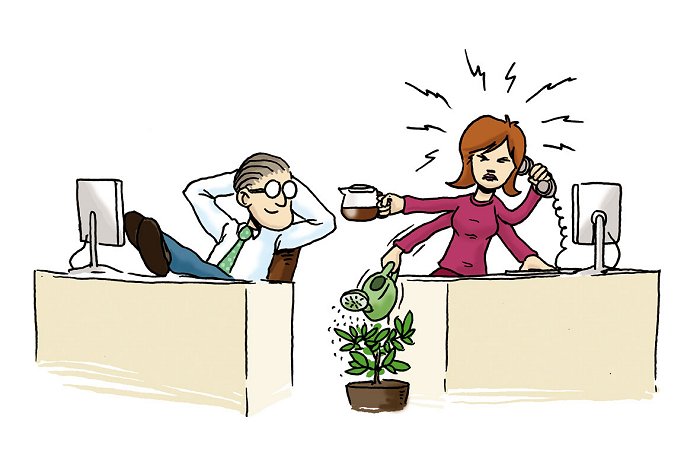
the tendency to take care of “domestic-tasks” as
they do at 185 home. However, it is important
that a woman does not make herself responsible
for regularly making coffee, washing the dishes,
watering the plants or any other cleaning or
organizational tasks. These should be shared
by everyone in the office regardless of gender,
and, unless they are written in your job description,
they should not be anyone’s sole responsibility.
Both male and other female colleagues are likely
to appreciate such motherly gestures, but by
calling attention to yourself for these actions
you run the risk of no longer being valued for
the true competencies that you bring to the job.
What should I wear?
Inappropriate dress can be
an even greater distraction from a woman’s
professional competencies. In the workplace, it
is important that women remember that looking “sexy” is
not the same thing as being “attractive”.
Although we briefly discussed a few dress tips
for women in Chapter “Business Attire”,
a woman hoping to make a serious and professional
impression should also remember these “dress
for success” rules:
- Skin is not “in” – if
there is anything that keeps people (both males
and females) from paying attention to what you
are saying, it’s a low-cut blouse, a short
skirt, a backless dress, bare legs, or a sliver
of belly peeking out at them. As summer temperatures
rise, some women feel tempted to reveal more skin,
especially when they see female colleagues running
around like they are at the beach. However, such
dress is not appropriate for a professional woman
in the workplace. If you want to be known for your
mental abilities and not your physical assets (or
lack thereof), keep things under cover. Also, never
forget to wear a slip under sheer skirts and dresses
and, regardless of the heat, to wear pantyhose
at all times. You do not want to be perceived as “sexually
provocative”.
- These shoes were made
for walking… Your shoes should
not be the first thing that people notice about
you; especially as you attempt to balance your
way through the conference room on extremely
high heels. The shoes you wear to work should
be conservative, stylish, of good quality, and
comfortable. It is best to stick with dark pumps
with a moderate heel or flats. Avoid stilettos,
wedge heels, trendy colors, odd designs or patterns,
open toed shoes, and especially boots with laces
as these can conjure up other images! Also, make
sure the shoes are comfortable before you wear
them to work. It is tempting to buy new shoes
before a big company event, but nothing is more
embarrassing than having to carry your shoes
in hand while tip-toeing on blistered feet towards
your car at the end of the day.
- The
workplace outside of the workplace -
Occasionally throughout the year, you will meet
with your colleagues for events outside of the
workplace. Whether you find yourself under a
company-sponsored tent at the Oktoberfest or
at the company’s
formal Christmas ball, it is still important
that your attire remain appropriate but fitting
for the event. The fact that you are no longer
in the office does not mean that you can forget
professional dress and etiquette, even though
this is especially tempting when the alcohol
starts flowing. Showing up in a tight little
black dress or letting your hair down and kicking
off your shoes when the music starts playing
could leave the wrong impression on your boss
and colleagues. Have fun at these events, but
respect yourself and others. You do not want
to start your next work day with a social hangover.
Romance at Work
Not only does a company structure
automatically group individuals based on their
abilities and interests, but everyday work life
gives us a chance to observe and get to know others
over a long period of time and in many different
situations. Considering this, and the fact that
many German companies are surprisingly accepting
of office romances, many Germans actually do end
up meeting their life partners at work. This is
good news for both single men and women who work
full-time. However, in a male-dominated workplace,
a woman’s professional reputation is unfortunately
more susceptible to criticism than a man’s
when it comes to office dating. If you decide to
date a colleague or if cupid’s arrow just
happens to hit you while you are sitting in front
of your computer, keep the following in mind:
- Resist
the urge to let everyone know immediately that
you are dating a colleague. Even if you are about
to explode from all the butterflies in your stomach,
try to maintain discretion. It is difficult to
accept rejection, but it is even more painful when
everyone in the office knows that you got “dumped”.
Once the two of you are sure that what you have
is more than a short fling, it is acceptable to
acknowledge your relationship, but be sure to continue
to refrain from displaying affection at work. This
is not acceptable professional behavior and it
can be very embarrassing when a colleague finds
you hugging or kissing each other in the elevator,
the coffee nook or the stairwell.
- If you
are in a relationship with a colleague, do not
spend company time calling, chatting and e-mailing
each other. Such behavior is annoying for colleagues
who have to listen to private conversations and
it causes you to waste work time with blatant
disregard for your professional responsibilities.
Try to limit the time that you spend with each
other to the lunch break, but again, resist displaying
affection until the work day is over.
- Things can
really get complicated for anyone who is dating
someone higher up the corporate hierarchy. Rumors
concerning attempts to “sleep your way to
the top” are not uncommon, and in such cases,
it is extremely important that the relationship
does not affect the professional life or responsibilities
of either partner. In fact, it is recommended that
one partner start looking for another job once
it is certain that they both wish to remain in
a long-term relationship. This is also only fair
to other employees who may perceive unfair advantages
being given based on the relationship.
- If
your boss or a married colleague begins to flirt
with you or to make suggestive comments, do not
feel compelled to flatter him by flirting back.
These are situations that can negatively affect
a woman’s professional reputation, and
this is especially unfair considering that most
women resent being placed in such uncomfortable
situations anyway. Do not respond positively
to the comments or advances, and use a serious
tone to set the matter straight immediately.
If you are continually harassed by anyone, speak
to the “Frauenbeauftragte” (women’s
ombudsman) who is responsible for your department.
She can give you advice and speak to the individual
on your behalf. If the situation does not improve,
German law does give you the right to file for
sexual harassment.
Mentors and other helpful
boosts up the ladder
If you are a young woman
beginning her career in Germany, you should try
to create a working relationship with other professional
women in your company who can mentor you. Some
of Germany’s larger companies employ quite
a few women and have the human resources necessary
to set up formal groups that match younger female
employees with older and more experienced female
mentors. If such a group does not exist in your
company, actively look for individuals who have
your best interests in mind and who are willing
to support you with advice and feedback along
your career path. Make it clear that you respect
them as a mentor and that you wish to advance
within your company. While a woman’s mentor
does not necessarily have to be another woman,
women are more likely to understand the obstacles
that you will face and they are more likely to
feel comfortable mentoring another woman. While
a mentor can help you build a professional network
and give you advice when things get tough, a
woman should also keep the following points in
mind on her climb up the career ladder:
- Once
you have established several important working
relationships, you will feel more comfortable
in your job and more confident in your future
at the company. However, you should never use
your professional relationships or friendships
to manipulate other colleagues or to brag. For
example, mentioning that you are invited to the
CEO’s son’s wedding will only make
your colleagues jealous and suspicious.
- Even
if you are still learning on the job, do not
lean back and let everyone serve you. Mentors
and other colleagues are happy to give advice
and help you out – in the beginning. If
you do not show appreciation for their efforts
or if you fail to return favors when the opportunity
comes along, you can quickly fall from grace.
It is particularly important that female employees
with professional ambitions show appreciation
and demonstrate their competencies so that they
do not get accused of relying on others (especially
attentive male colleagues) to enable them in
their work.
- Every office consists of
different characters and personalities, and some
of these can be very difficult to deal with on
a day-to-day basis. If you are one of few women
at your workplace, it is not unlikely that you
will be a popular target for the “alpha-dog’s” jealousies,
the bigoted colleague’s tirades, the macho’s
bad jokes, or even the depressed colleague’s
trials and tribulations. It is important that
you make it clear to your colleagues that you
are neither a social worker nor a punching bag.
Most importantly, though, do not let these personalities
unsettle or intimidate you. Use your best judgment
when dealing with such people and be confident
in your daily decisions and your work performance.
- Finally,
remember to respect everyone regardless of their
position or their placement in the corporate
hierarchy. The Germans have a saying: “Man
sieht sich ja immer zwei mal im Leben” (people
see each other at least twice in a lifetime).
They also like to apply this to the corporate
climb. If you pass someone going up the ladder,
you will also pass them coming back down. For
this reason, it is important that you show all
of your colleagues respect. This includes resisting
office gossip and not talking negatively about
others behind their backs.
Internet addresses that could be of interest to
women: (mostly in German)
You will find the article
also in our book. Click on the image to order
directly.
Enjoy reading!

This new learning software with extensive text
excerpts from the successful business
etiquette book.
Keywords: small
talk,
sucessful with german clients, german business
protocol , german business practices versus
american , german business practices , german
business etiquette and manners , german business
culture characteristics , german business culture
, german business correspondence etiquette ,
business etiquette in Germany , business communication
germany etiquette
|
NEW
EDITION!

Direct book order via PayPal >>>
or
via
credit card or bank transfer >>>
|