|

More than manners
Tips for business professionals visiting Germany
by Joachim
Graff & Gretchen
Schaupp
Germany is a major trading partner for many countries throughout
the world, not to mention the most important single market in the
European Union. Almost everyone wants to be active in this market,
and for the most part, almost everyone already is. For this reason,
stiff competition exists among many almost identical products and
services.
This fact not only leads to increased pressure to differentiate
product quality and characteristics, but it also increases the importance
of how a business presents itself to the German market. Of course,
a company's products play a large roll in its performance, but,
more subtly, so do its employees.
Most of us know just how important social behavior are when doing
business in our own cultures, and this holds true when working abroad
as well. Whether one is taking part in trade fairs, carrying out
price negotiations with partners or colleagues, talking with end-customers,
or applying for a job abroad, appropriate business conduct helps
create mutual trust and understanding and is, therefore, often the
key to business cooperation and success.
But what behavior are expected in Germany, a country where the
people are known for their guttural language, their obsession with
"Ordnung", their square-jawed seriousness, and other habits
and sensitivities?
You can help ensure the achievement of business success with the
Germans when you are informed about the cultural differences and
expectations in Germany and the situations in which they are important.
It is then possible to act appropriately when the time comes and
improve your chances of closing that "big deal" or establishing
respectful working relationships thus setting yourself and your
organization ahead of the competition.
The purpose of this book is to help the business professional
or student prepare for an assignment in Germany. We surfed the web,
combed through the literature, and talked to a whole spectrum of
foreign professionals working in Germany. After lots of brainstorming,
we developed a list of practical and useful guidelines for helping
business students and professionals negotiate the social challenges
of a business encounter. Our advice is also designed to help avoid
uncomfortable situations and tactfully handle predictable and unpredictable
situations at all social levels in German business. Correct conduct
with German colleagues and customers, how to master negotiations,
the correct tone to use in e-mails and letters, and table manners
are just some of the topics that can prepare you for a successful
trip to Deutschland.
FORWARD TO THE SECOND EXPANDED EDITION (2006)
Two years have gone by since the first edition of More than Manners came out, and we were thrilled by the great response that our book received. In this edition, we have included even more suggestions and questions that have come from our readers. In an effort to remain true to the book's compact form, we have also managed to keep the chapters short and packed full of useful information. Several chapters have been completely revised in order to keep up with today's chang-ing business environment. These include "E-mail Etiquette" and "New Strategies for the Job Hunt". We have also included several com-pletely new topics for which we have noticed increasing interest: "Efficient Meetings", "Celebrating at Work", "Small Talk", "How to Read Job Ads", and "In Case of Emergency: Information for Visitors to Germany". Suitable manners and cultural knowledge have gained even more importance in the last few years. Main driving forces in the business arena today are constant competition and pressure for success, regardless of whether this is with colleagues, customers or while applying for a job. This is of special significance for Germany – the world's export champion of the year in 2014 – because hardly any other country has such a complex network of business relationships reaching across international borders. There is strong pressure on Germany to open up new markets and decrease expenditures. This will continue because of high domestic wages and great market po-tential in foreign countries. Therefore, Germany remains an attractive partner for foreign businesses. Successful business relations start with knowledge of the German market, German business and social etiquette and German culture. For example, an American dental supplier was confronted with a problem in recent years when, despite superior quality, it was not able to place products successfully on the German market because German-specific issues were ignored. This is where our book offers useful support to foreigners who are planning on doing business in Germany. Special thanks go to Barbara Parsons for her help with the English version and to Martin Schippel for his help with the German version of this second edition.
FORWARD TO THE THIRD EXPANDED EDITION
While preparing this new edition of what has turned out to be a fairly successful book, we came to realize that many other books address-ing similar topics are being published along with ours. This proves that “good manners” are finally gaining popularity again in Germany. Many of these books are published in German and their titles contain the word “Knigge” – a term the Germans use when referring to correct behavior. Before we go any further, we would like to explain to our foreign readers what “Knigge” means and where it originated: Baron von Knigge lived from 1752 to 1796 as a writer and philosopher in northern Germany and coined the term “Knigge” with his publication "Über den Umgang mit Menschen" (“How to Associate with People”), which first defined the behaviors that signal a good upbringing and how these should be passed from one generation to the next. With all due respect to the Baron, we have again tried to summarize German “Knigge” while keeping a focus on those behaviors that are especially important in the workplace.
In this edition, we have revised the chapters “Business Dinners”, “Traveling with the German Rail-way”, and “Networking” and we have included several new chapters: “The first 100 Days in a German company”, “How can I be a good boss?”, “Women in the German Workplace”, “Changing Jobs”, and “Business start-ups in Germany”. We hope you’ll enjoy the read.
This book is divided into three sections.
- The first section contains ten basic behavior tips,
- the second section will provide you with a few guidelines on
applying for a job or an internship in Germany, and
- the last few chapters contain tips on the more baffling aspects
of German business culture such as carrying out negotiations,
networking, and dealing with conflict.
Because these tips can be just as helpful for actual Germans, we
have written the book in both German and English. As a foreigner,
you should take advantage of the dual language aspect of the book,
and refer to the glossary to help you understand key terms. Finally,
remember that cultural differences might seem daunting at first,
but they are also what attract us to foreign cultures and essentially
make doing business in foreign countries challenging, interesting,
and fun.
CONTENT
At this point, the authors would like to mention that this book
could not have developed into its final form without the cooperation
and intense discussion that took place between both English and
German native speakers, and we would like to thank everyone who
assisted us. We especially thank Nicholas Lusty from England and
Barbara Parsons and Jason Rihel from the USA for their help with
the English version, as well as Gerhard Beck, Kristina Zimmermann
and Frauke Thiele for their help with the German version.
A special thanks goes to Alexandra von Rohr, who, through her ongoing
work with German language and business courses ( www.learn-german-home-german-home-tuition.com),
was able to guide and inspire us throughout the writing process.
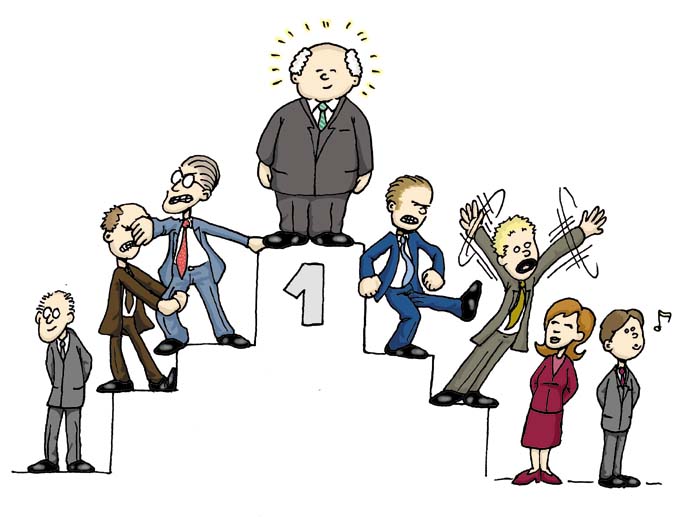
We also appreciate the creative work of Günter Mayer (www.comixart.de)
and thank him for his never-ending patience and his talents, which
allowed us to illustrate the book and give it its own personality.
Finally, we thank all of the teachers and students in the German
intensive courses at the TREFFPUNKT Language Institute. If it hadn't
been for their questions, expectations, ideas, and perceptions of
cultural differences, the motivation for this book would never have
been triggered.
To read current updates on the topics in this book, to find out
about related topics check our website. In the near future there
will also be a discussion forum. 
Gift voucher for German online lessons
Keywords: sucessful
with german clients, german business protocol , german business practices
versus american , german business practices , german business language
, german business etiquette and manners , german business etiquette
, German business environment , german business dinner table settings
, german business customs , german business culture essays , german
business culture characteristics , german business culture , german
business correspondence etiquette , german business , german as a
business langauge , gender differences in german business , english
to german business terms , business german and training , business
german , business etiquette in Germany , business communication germany
etiquette
Online Certificate Programs at Washington Tech
Christian School Online
attend Online High School at Excel
| Business And Science |
Experts at Assignment Geek will make you love your homework
Boost your language skills with the best Private Language Schools worldwide
CaseStudyHub.com find Business case studies and writing tips.
|
ORDER NOW

as paperback or ebook!
Direct book order >>>
|



 special price by TREFFPUNKT-ONLINE